
Laser Scanning & BIM Coordination for Materials Recovery Facilities
MRF capacity expansion projects carry a specific risk: equipment is expensive, production cannot stop for extended periods, and the gap between what the drawings show and what is actually in the facility can be significant. OAR provides fast 3D Laser Scanning and BIM Coordination & Virtual Construction services that give MRF operators verified existing conditions before equipment is engineered, procured, or installed.
OAR serves MRF operators and project teams across the Northeast: Connecticut, Massachusetts, Maine, New Hampshire, New York, Rhode Island, and Vermont. BIM Coordination & Virtual Construction is delivered remotely nationwide.
Most MRF installation conflicts trace back to one source.
Planning against drawings that do not reflect the current state of the facility. Conveyors get extended, overhead structure gets modified, utility routing changes, and none of it makes it back to the original drawings. When an optical sorter or conveyor system is engineered to those drawings, the conflict does not surface until the equipment is on site.
Resolving a field conflict after equipment arrives costs significantly more than identifying it at the planning stage. OAR’s role is to close that gap before it becomes a problem.
Three services. One accountable partner.
Non-Intrusive 3D Laser Scanning in Active Operations
Verified field conditions. Zero disruption to throughput.
OAR scans MRF facilities during scheduled access windows without disrupting sorting operations. Overhead structure, conveyor systems, optical sorter positions, utility routing, and spatial constraints are all captured with millimeter-level accuracy while the facility continues running.
As-Built Documentation for Capital Project Planning
The facility as it exists today, not as it was originally built.
OAR delivers registered point clouds and Revit models that reflect the facility as it currently exists. Equipment suppliers and installation contractors use this verified data to engineer and plan against actual field conditions, eliminating the assumptions that generate conflicts.
BIM Coordination for Equipment Installations
Conflicts resolved before fabrication begins.
OAR manages clash detection between new equipment and verified existing conditions. Optical sorter conflicts with overhead structure, conveyor integration issues at transfer points, and utility connection conflicts are identified and documented before fabrication and installation begin.
Project types we work on.
Clash detection between new optical sorters and verified existing conditions: overhead structure clearances, conveyor positions, utility routing, and spatial constraints.
Scan-verified existing conditions for conveyor routing, transfer point integration, and structural support planning.
Verified clearance and load point documentation for equipment mounting, hanging conveyors, and overhead utility routing.
Verified facility dimensions for capacity expansion planning. Eliminate assumptions before engineering budgets are committed.
Ongoing as-built documentation across multiple project phases for MRFs undergoing long-term capital improvement programs.
From field conditions to usable data.
High-density point cloud data captured during active operations. Delivered in .RCP, .RCS, or .E57 format, ready for your engineering and coordination workflow.
LOD 300 Revit models reflecting verified existing conditions: structure, conveyors, overhead systems, utilities. The foundation for all capital project engineering.
Every conflict between new equipment and existing facility conditions identified and documented before procurement and fabrication. Hard clashes, soft clashes, and clearance violations all tracked.
Shared BIM model giving equipment suppliers verified field geometry during engineering. Eliminates the back-and-forth that happens when suppliers are working from assumptions.
A verified digital record of the facility as it exists today, accessible for future capital projects and planning cycles without requiring additional site visits.
Laser scanning and BIM coordination in an active MRF.
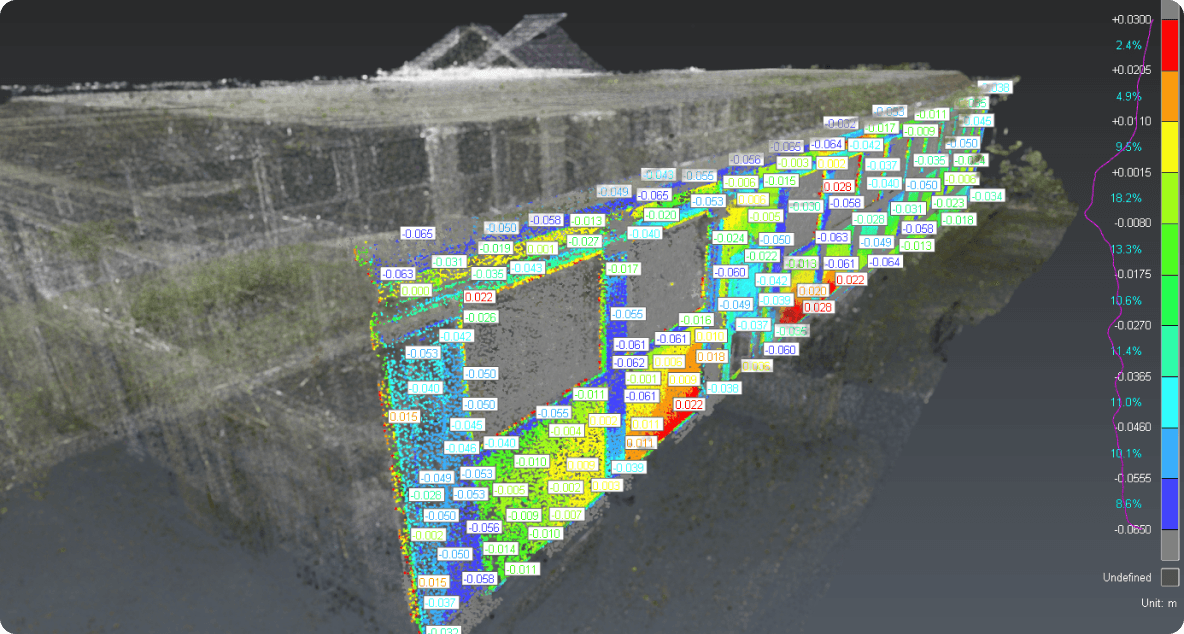
Large-Scale MRF Optical Sorter Installation
California · Active Single-Stream MRF · Equipment Integration
Facility scanned
Spatial conflicts identified before fabrication
Field conflicts at installation
An active single-stream materials recovery facility needed to install a new optical sorter into existing overhead structure without disrupting ongoing operations. OAR performedaccelerated weekend scanning of the full facility, delivered a LOD 300 Revit model, and ran clash detection against the new equipment model. All 27 conflicts were resolved before fabrication began. The equipment was installed without a single field conflict.
From the field.
“OAR’s team has been great to work with throughout multiple large-scale scan to BIM projects. High attention to detail, accurate scan data, proper BIM implementation and consistent communication and support from OAR has helped to improve our project quality and efficiency from start to finish.”
“We had a 72-hour shutdown window. OAR’s coordination work meant our crew walked in knowing exactly what to do. Zero surprises. We hit every milestone and came back online on schedule.”
“Professional, timely and highly accurate scanning and modeling by OAR has saved me $$$. Having a single 3D source of truth for engineers, OEMs and tradesmen made my last project a breeze.”
Frequently asked questions
Yes. OAR performs non-intrusive laser scanning in active MRF operations during scheduled access windows, without disrupting sorting lines or conveyor systems. Scanning is coordinated with facility management to minimize production impact.
Laser scanning captures verified existing conditions including overhead structure clearances, conveyor positions, and utility routing. Equipment suppliers use this data to engineer optical sorters to actual field geometry, preventing installation conflicts before the equipment arrives on site.
As-built documentation is a verified record of the facility as it currently exists, built from laser scan data. MRFs accumulate years of modifications that never make it back to original drawings. As-built data gives project teams a reliable foundation for capital equipment planning.
OAR supports optical sorter installations, conveyor system expansions, overhead structure documentation, multi-phase facility upgrades, and capacity expansion feasibility projects. We serve MRF operators across the Northeast and take coordination scope work nationwide.
BIM coordination uses verified as-built models to run clash detection between new equipment and existing facility conditions. Conflicts are identified and resolved before fabrication and installation begin, reducing the risk of field conflicts and unplanned shutdown time.
Tell us about your facility and what you are planning. We will figure out the right scope together.